What are the Most Traded Commodities?
Revised on: 07/26/2023
Liquidity is the most important factor you should consider when trading commodities. This is because a commodity's liquidity determines how easily traders can buy and sell the commodity. Simply put, liquidity is a measure of the number of buyers and sellers in the market and whether transactions can be executed seamlessly.
When commodity trading activities are very active and there is both high supply and demand, the market in question is highly liquid. Highly liquid markets are generally less risky because there is usually someone else willing to take the other side of the position. High liquidity also means that traders are less likely to experience slippage.
Slippage refers to the difference between the order price set by a trader and the actual price at which the trade is executed. Slippage can work in your favor or against you - for example, trading illiquid commodities can lead to larger losses.
Furthermore, illiquid commodities are often subject to strong price fluctuations. So if you want to trade in the commodity market, you should try to focus on liquid commodities. Liquid commodities include energy (e.g., oil and natural gas), precious metals (e.g., gold and silver), and agricultural products (e.g., cotton, soybeans, and wheat), i.e., those with high trading volumes.
Risk Management Tools
One way to manage liquidity risk is to use risk management tools such as guaranteed stop losses, a type of stop-loss order that ensures your position is closed at a pre-selected price.
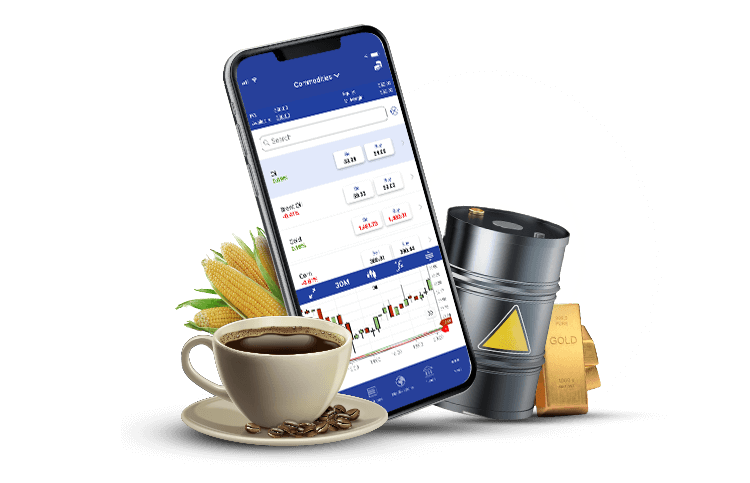
Prices for illustration only.
Most Traded Commodities
The following list of the most traded commodities is based on data collected by the Futures Industry Association (FIA).
- WTI Crude Oil
- Brent Crude Oil
- Natural Gas
- Soybeans
- Corn
- Gold
- Copper
- Silver
West Texas Intermediate (WTI) Crude Oil
West Texas Intermediate (WTI) Crude Oil (Trading Symbol: CL) is the global benchmark
for crude oil pricing.
It is considered one of the three benchmark commodities for oil trading, alongside
Brent Crude Oil and Dubai Crude Oil.
This benchmark specifically originates from the "Permian Basin" in the US, primarily
from Texas.
Like many benchmarks, this price is also important for buyers and sellers of crude
oil as it is often used as a reference when purchasing oil.
As it is relatively light, it is referred to as medium crude oil, and due to its low
sulfur content (approx. 0.34%), it is called sweet crude oil.
It forms the basis for the New York Mercantile Exchange's oil futures contracts.
Click here to learn more about CFD trading with Oil >
Brent Crude Oil
Brent Crude Oil (Trading Symbol: EB) is one of the three major benchmark oils and is
said to account for two-thirds of the world's oil trading volume.
Therefore, Brent Crude Oil is considered the most widely used benchmark for crude
oil worldwide.
It is produced in the North Sea region and is the main traded light sweet crude oil,
also serving as a reference price for global crude oil purchases.
As it is relatively light, it is referred to as light oil, and due to its low sulfur
content, it is called sweet oil.
Click here to learn more about CFD trading with Brent Crude Oil >
Soybeans
Soybeans (Trading Symbol: ZS) are one of the most active and popular agricultural
commodities.
In fact, global soybean production has grown exponentially over the past 20 years,
with its market value more than doubling to reach $123 billion.
This could be partly due to their versatile and multifunctional nature, as they can
be used to produce soybean oil, soybean meal, and for other purposes.
According to the US Department of Agriculture (USDA), the US is the main producer
and exporter of soybeans, primarily exported to China, the European Union, Japan,
Mexico, and Taiwan.
Soybeans account for 90% of total US oilseed production, with the US accounting for
44% of global soybean exports and 35% of global soybean production in 2010.
Click here to learn more about CFD trading with Soybeans >
Natural Gas
Natural Gas (Trading Symbol: NG) is a non-renewable hydrocarbon that, like most
fossil fuels, originates from plants, animals, and microbes that lived long ago.
This fossil fuel is also used as an energy source for various purposes such as
industrial, domestic, and power generation.
Therefore, it is used for heating, cooking, and electricity generation.
It is also used as a fuel for vehicles and as a chemical feedstock in the production
of plastics and other commercially important organic chemicals.
Most of the world's natural gas is produced in the US, followed by Russia, Iran,
Qatar, China, and Canada, with the largest consumers being the US, Russia, and
China.
Click here to learn more about CFD trading with Natural Gas >
Corn
Corn (Trading Symbol: ZC) is an important food source and is also used as animal
feed and for ethanol production.
The world's major corn-producing countries include Argentina, Brazil, China, and the
US.
As an agricultural product, poor weather can negatively affect corn supply.
Another factor influencing corn prices is the extent of agricultural subsidies by
government agencies.
In the US, corn production is heavily subsidized, strongly encouraging farmers to
continue cultivating this crop.
Furthermore, corn production can be influenced by geopolitical factors.
For example, the corn supply chain in many countries such as China, Egypt, Iran, and
Israel, which import corn products from Ukraine, was significantly disrupted by the
war between Russia and Ukraine that broke out in February 2022, leading to a sharp
increase in prices for corn and other food items.
Click here to learn more about CFD trading with Corn >
Gold
Throughout recorded history, gold (Trading Symbol: XAU) has been highly
sought after due to its beautiful appearance and value storage properties.
It is mainly produced in Russia, Australia, South Africa, the US, and Canada.
It is also considered one of the oldest currencies in history. Therefore, it is
regarded as a safe haven.
Although the traditional uses of gold have not changed, it is now also considered a
key component in electronics manufacturing.
Although the gold price is relatively stable, there are many factors that can
influence its price, such as inflation and deflation.
Even the Federal Reserve's monetary policy, supply and demand, and geopolitical
factors can affect the price of this precious metal.
Click here to learn more about CFD trading with Gold >
Copper
Like gold, copper (Trading Symbol: HG) is widely used in the electronics
industry due to its excellent conductivity.
Due to its broad application in manufacturing, the copper price tends to fluctuate
with changes in economic performance.
The main copper-producing countries are Chile, China, and Peru.
Click here to learn more about CFD trading with Copper >
Silver
Like gold, silver (Trading Symbol: XAG) has been highly sought after as a
precious metal.
Furthermore, silver is frequently used in the production of solar cells and
photographic films.
Although silver is also considered a precious metal, most people prefer gold as it
is seen as a more reliable store of value.
Click here to learn more about CFD trading with Silver >
Trading Popular Commodities
It is important to note that each commodity is different and therefore its prices are influenced by different factors. For example, the prices of gold and silver can be influenced by an increase or decrease in jewelry demand and changes in the demand for value storage. In times of economic instability, the demand for gold or gold-related investments may increase as a means to protect investors' assets. Therefore, thorough analysis is essential before deciding to trade commodities.
Track Crypto offers world-leading CFD trading services for commodities. The user-friendly and advanced online CFD platform includes a free demo account, various learning resources, and trading tools for beginners and experienced traders. Traders can also utilize Track Crypto's free education section, which provides useful FAQs, trading videos, and free e-books. The company has some of the lowest spreads in the industry, and the intuitive platform is not only easy to use but also provides in-depth analytical insights and complex trading options. You can use the free Track Crypto demo account to test your strategies and explore various commodity trading opportunities before investing real money.
The general information contained in this article does not take into account your personal circumstances.
More from Track Crypto
Expand Your Knowledge
Discover deeper insights through informative videos, articles, and guides in our Trading Academy.
Discover +Insights
Stay updated on what's happening inside and outside of Track Crypto.
Prepare for Your Trading
Our Economic Calendar helps you explore global market events.
